Basic information
| Field | Details |
|---|---|
| Full name | Joseph Patrick Kennedy Jr. |
| Birth date | July 25, 1915 |
| Birthplace | Hull, Massachusetts, United States |
| Parents | Joseph P. Kennedy Sr. and Rose Fitzgerald Kennedy |
| Siblings | John F. Kennedy, Rosemary Kennedy, Kathleen Cavendish, Eunice Kennedy Shriver, Patricia Kennedy Lawford, Robert F. Kennedy, Jean Kennedy Smith, Edward M. Kennedy |
| Education | Choate, London School of Economics, Harvard University |
| Military branch | United States Navy |
| Known for | Eldest Kennedy son, naval aviator, wartime volunteer, posthumous Navy Cross recipient |
| Death date | August 12, 1944 |
| Legacy | Joseph P. Kennedy Jr. Foundation, USS Joseph P. Kennedy Jr. |
The eldest son in a family built like a cathedral
I see Joseph P. Kennedy Jr. as the cornerstone of a family. Ambition was a lifestyle in his family. Joseph P. Kennedy Sr. and Rose Fitzgerald Kennedy had their first child in Hull, Massachusetts, on July 25, 1915. Expectation was on him from the start. In the Kennedy family, the oldest son was expected to lead, excel, and set the tone.
He was raised with discipline, competition, and polish. His family valued Catholicism, civic duty, and success. The Kennedys were huge, active, close, and motivated. I think Joseph Jr. was supposed to be the clan’s first public face. Joseph Jr. was heir apparent before his younger brother John and Robert became major figures in law and politics.
Education, ambition, and a life aimed at public service
Joseph Jr. was educated at Choate, then at the London School of Economics, and later at Harvard University. He graduated cum laude in 1938. That detail matters because it shows the shape of his mind. He was not merely a social figure from a wealthy family. He was disciplined, capable, and serious about his future.
He seemed to be moving toward politics. In 1940 he served as a delegate to the Democratic National Convention, a sign that the public stage was already opening before him. He even began studying law at Harvard, but war changed the direction of his life. Like a ship caught by a sudden tide, his path was pulled away from politics and into military service. He chose to leave Harvard Law School and volunteer for the Navy. That choice says a great deal about him. He could have stayed safe in the shelter of privilege. Instead, he went toward danger.
Naval service and wartime achievement
Joseph Jr. became a naval aviator in 1942. By 1943, he was sent to Britain, where he flew patrol missions in B-24 aircraft under British Naval Command. These were not ceremonial flights. They were demanding, exhausting, and dangerous. He was part of the effort to fight Nazi Germany in the air and over the sea.
His service reached its most perilous point when he volunteered for Operation Aphrodite, a secret mission involving explosives packed into an aircraft that would be remotely guided toward enemy targets. It was a mission built on nerve, risk, and fragile technology. Joseph Jr. agreed to take part in one of the most dangerous assignments of the war. That choice places him in the category of men who did not wait for glory, but stepped toward danger when duty called.
He died on August 12, 1944, when the aircraft exploded prematurely over Suffolk, England. He was only 29 years old. His body was never recovered. The loss was final, abrupt, and brutal. For the Kennedy family, it was like a bell breaking in the middle of a hymn.
His military record earned posthumous honors, including the Navy Cross and the Air Medal. The Navy later named a destroyer after him, and his family established the Joseph P. Kennedy Jr. Foundation in 1946. His wartime sacrifice became one of the central emotional pillars of Kennedy family memory.
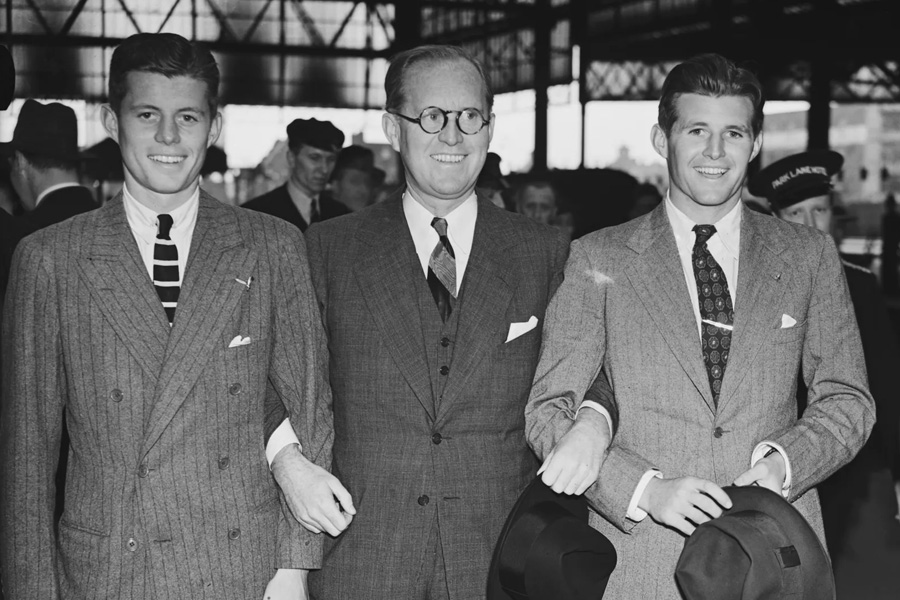
Joseph P Kennedy Jr and his parents
Joseph P. Kennedy Sr. was more than a father. He was the architect of the Kennedy family machine, a businessman and diplomat who built wealth and expected excellence in return. I see him as a man who shaped the family with both opportunity and pressure. He wanted his children to succeed in public life, and Joseph Jr. was the child first positioned to carry that burden.
Rose Fitzgerald Kennedy was the family’s steady center. She came from a prominent Boston political family and brought both faith and formality into the home. She had nine children and maintained a household with order, tradition, and high expectations. Her role was not passive. She helped form the tone of the entire family, and that tone echoed through every child’s life.
Together, Joseph Sr. and Rose created a home that was wealthy, ambitious, and deeply concerned with public reputation. Joseph Jr. stood at the front of that household’s hopes.
Joseph P Kennedy Jr and his siblings
While Joseph Jr. was alive, John F. Kennedy, the younger brother who would become president, was the shadow of his elder brother. Their relationship was loving and competitive. I envisage a silent chat between brothers comparing themselves.
Rosemary Kennedy, the oldest daughter, had a lobotomy that severely handicapped her. Her life was one of the family’s most difficult stories and affected their private world in ways outsiders missed.
Kathleen Kennedy, then Kathleen Cavendish, married into British royalty and was glamorous and independent. In 1948, a plane tragedy ended her short life. She was another family member in worldwide society.
Eunice Kennedy Shriver became one of the family’s greatest public workers, championing intellectual disability rights. Her work gave the Kennedy name a lasting moral mission.
Patricia Kennedy Lawford married actor Peter Lawford after entering media and society. The family’s public life and campaigning included her.
Robert F. Kennedy was a powerful family member due to his legal and political career. High intensity, moral urgency, and public impact defined his career.
Diplomat and philanthropist Jean Kennedy Smith became US Ambassador to Ireland. She connected family to culture and international goodwill.
The younger brother, Edward M. Kennedy, was the Senate’s longest-serving lion and characterized Democratic politics for decades.
Personal character and legacy
What strikes me most about Joseph P Kennedy Jr. is how much was expected of him and how much he still chose to do. He was born into wealth, but he did not live as if comfort were enough. He trained, studied, flew, and volunteered for an assignment that could only be called perilous. His life was brief, yet it was not small.
The family legacy that followed him was immense, but his own story remained distinct. He became the son whose absence reshaped the family tree. After his death, the burden of political destiny shifted toward John and then to the rest of the siblings in different forms. In that sense, Joseph Jr. is like the first flame in a row of candles, the one that gave shape to the light that followed.
FAQ
Who was Joseph P Kennedy Jr.?
Joseph P Kennedy Jr. was the eldest child of Joseph P. Kennedy Sr. and Rose Fitzgerald Kennedy. He was educated at Choate, the London School of Economics, and Harvard, and he served as a naval aviator during World War II.
Why is Joseph P Kennedy Jr. important?
He was the first Kennedy son expected to enter public life, and his wartime death in 1944 changed the direction of the family’s future. His sacrifice also became part of the Kennedy family’s public legacy.
How did Joseph P Kennedy Jr. die?
He died on August 12, 1944, when his aircraft exploded prematurely during Operation Aphrodite over Suffolk, England. The mission was extremely dangerous and remained one of the war’s secret programs.
What was his relationship with John F. Kennedy?
John F. Kennedy was his younger brother. Their relationship was close, competitive, and deeply significant. After Joseph Jr. died, much of the family’s political expectation shifted to John.
What honors did Joseph P Kennedy Jr. receive?
He received the Navy Cross and the Air Medal posthumously. The Navy also named a destroyer in his honor, and the family later created the Joseph P. Kennedy Jr. Foundation.
How many siblings did Joseph P Kennedy Jr. have?
He had eight siblings: John, Rosemary, Kathleen, Eunice, Patricia, Robert, Jean, and Edward. Together, they formed one of the most famous American families of the twentieth century.